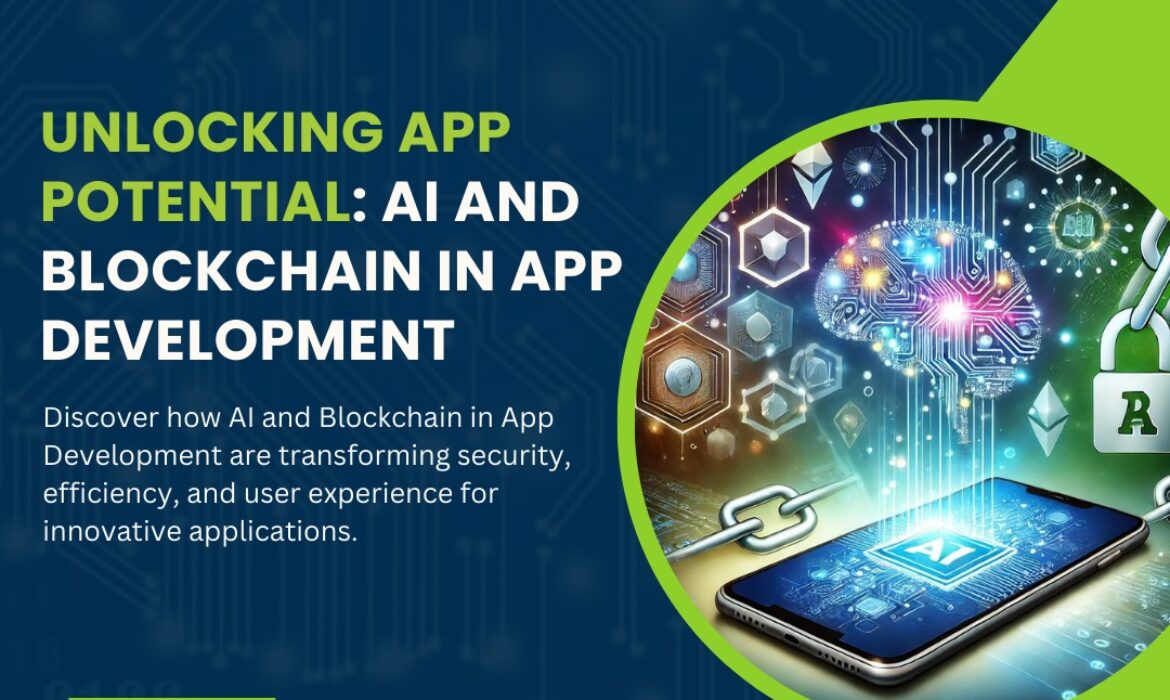
Today, two revolutionary forces of the technological world are Artificial Intelligence (AI) and Blockchain, which are remodeling industries in ways that have never been imagined before. When these innovations merge into app development, they unlock transformative possibilities about how we create, secure, and interact with applications. The synergy of AI and blockchain in app development is more than a concept; it’s revolutionizing the field, paving the way for advanced functionalities, enhanced security, and user-centric applications across various sectors. As industries integrate these technologies, they redefine the face of app development and usher in a new age of digital innovation.
As organizations embrace AI and blockchain, the future of app development is being redefined. This blog explores how these technologies are adding value to app development and highlights real-world applications and benefits.
The Rise of AI and Blockchain in App Development
- Understanding Blockchain and AI:
- Blockchain is a decentralized ledger technology that ensures transparency and security by creating unalterable data records across networks.
- AI empowers machines to learn from data, make decisions, and complete tasks autonomously, enhancing the overall intelligence and efficiency of applications.
- Together, AI and blockchain have the potential to elevate app development, providing apps that are both powerful and secure.
- Growing Market Demand:
- The AI market is predicted to reach almost $1 trillion by 2027.
- The blockchain industry is projected to grow at a compound annual growth rate (CAGR) of 87.7% from 2023 to 2030.
- As these markets expand, their integration in app development holds substantial potential, offering cutting-edge features that redefine the app ecosystem.
Key Advantages of Combining AI and Blockchain in App Development
Enhanced Security and Trust
- Data Security:
- Blockchain’s decentralized nature distributes data across a network, eliminating risks associated with centralized data storage and reducing single-point-of-failure vulnerabilities.
- This architecture makes data manipulation and unauthorized access difficult, creating a secure environment for sensitive information.
- AI-Driven Threat Detection:
- AI can proactively monitor blockchain networks, detecting unusual activities and identifying security threats in real time.
- For example, AI can analyze transaction patterns on the blockchain, flagging suspicious activities before they escalate.
- By leveraging AI, developers can build robust security systems, enhancing user trust in the app’s integrity.
- Transparency for Users:
- Blockchain’s immutable nature ensures that users can trace transaction histories, fostering transparency.
- With AI’s data analysis capabilities, users get insights into transaction histories, further reinforcing trust in-app security.
Improved Efficiency and User Experience
- Optimized Transactions:
- AI can predict blockchain network congestion, rerouting transactions for faster processing and reduced wait times.
- This optimization ensures that applications perform efficiently even during peak times, enhancing user satisfaction.
- AI-Powered Personalization:
- With AI, applications can adapt to user behaviors, offering tailored recommendations and personalized experiences.
- For example, AI-driven virtual assistants or chatbots can engage with users in real time, addressing queries, suggesting products, or guiding navigation within the app.
- Scalability:
- AI algorithms can manage the flow of transactions, dynamically adjusting based on usage to ensure the app remains scalable as demand grows.
- This AI and blockchain integration creates apps that can handle higher traffic volumes without compromising performance.
Transparent and Decentralized App Ecosystems
- Decentralized Applications (dApps):
- Traditional applications rely on centralized servers, leading to privacy concerns and data silos.
- Blockchain’s decentralized model enables users to control their data without dependency on central entities, ensuring privacy and transparency.
- AI for Enhanced Privacy:
- AI algorithms can work within dApps to provide personalized experiences without compromising privacy.
- For example, decentralized finance (DeFi) platforms can use AI to analyze user interactions and market trends to offer tailored financial advice.
- Empowering Users with Ownership:
- Blockchain allows users to own their data, enabling applications that respect user autonomy.
- Combined with AI, users can receive customized services while retaining full control over their personal information.
Industry-Specific Transformations
- Finance:
- AI and blockchain are transforming financial applications by enhancing security, analyzing transaction data, and providing real-time insights.
- AI can detect fraudulent transactions within seconds, while blockchain offers secure transaction records.
- DeFi platforms leverage AI for personalized investment recommendations, automated trading, and market analysis, fostering a transparent and secure financial environment.
- Healthcare:
- In healthcare, AI and blockchain can securely store and analyze patient data, enabling more accurate treatment recommendations.
- For instance, patient records on a blockchain offer unalterable medical histories, while AI analyzes these records to suggest personalized care plans.
- Supply Chain Management:
- Blockchain can track every product stage, providing transparency from production to distribution.
- AI can predict supply chain demands, optimize routes, and manage inventory, reducing wastage and improving operational efficiency.
- IBM’s Food Trust platform, for example, uses blockchain to track food products while AI enhances inventory management.
Real-World Applications of AI and Blockchain in App Development
- Enhanced Identity Verification:
- AI-powered applications can verify user identities using blockchain to securely store and validate credentials.
- This combination is particularly valuable in applications where user authentication is critical, such as finance or healthcare.
- Automated Smart Contracts:
- Smart contracts on blockchain enable self-executing contracts without intermediaries.
- AI adds further intelligence by analyzing contract terms, automating decisions, and flagging potential risks.
- These automated processes streamline workflows, reduce manual intervention, and cut operational costs.
- Improved Data Management:
- AI can categorize, process, and analyze vast amounts of data stored on blockchain, providing actionable insights.
- This is beneficial for industries that rely on data accuracy, such as banking, insurance, and government sectors.
- Secure Voting Systems:
- Blockchain’s transparency, combined with AI’s data analysis, can enable secure, verifiable, and anonymous voting systems.
- These applications can ensure election transparency and prevent fraud by verifying voter authenticity and monitoring suspicious activities.
- Intelligent IoT Integration:
- In the Internet of Things (IoT) ecosystem, AI and blockchain provide secure, efficient, and automated interactions among devices.
- Blockchain secures IoT data, while AI optimizes device performance by predicting maintenance needs and adapting device settings based on usage patterns.
Challenges in Integrating AI and Blockchain
- Scalability Constraints
- Both AI and blockchain demand high computational resources, making scalability a challenge.
- Blockchain’s data-intensive processes can slow down systems, while AI’s algorithms require substantial processing power, especially in real-time applications.
- Solutions like edge computing and hybrid architectures are emerging to manage computational loads, though scalability remains a primary focus for developers.
- Data Privacy Concerns
- AI needs data to improve, while blockchain ensures data immutability.
- Balancing AI’s data requirements with blockchain’s privacy protocols can be challenging, as blockchain’s transparency might reveal sensitive information.
- Techniques such as differential privacy and zero-knowledge proofs are being explored to address this privacy challenge.
- Interoperability and Standardization
- AI and blockchain technologies must communicate seamlessly within applications to achieve optimal performance.
- Current interoperability issues limit these technologies’ widespread integration, requiring the development of common protocols and standards for consistent functionality.
- Resource Costs
- The integration of AI and blockchain can be resource-intensive, requiring specialized hardware and expert development teams.
- Despite higher upfront costs, companies investing in these technologies are often rewarded with applications that provide long-term value and differentiation.
Future Opportunities for AI and Blockchain in App Development
- Decentralized AI Models:
- By using decentralized AI models, developers can reduce reliance on centralized servers, aligning with the blockchain’s decentralized nature.
- This enables more secure and efficient AI applications, allowing models to be trained across decentralized networks.
- AI and Blockchain-Powered Metaverse:
- As the concept of the metaverse grows, AI and blockchain are likely to play central roles.
- Blockchain ensures ownership of virtual assets, while AI can create responsive, interactive virtual environments that enhance the user experience.
- Secure Data Marketplaces:
- Blockchain-based data marketplaces allow users to control and monetize their data.
- AI algorithms can analyze marketplace trends and optimize data trading, making it a transparent and efficient system for data exchange.
Conclusion
The convergence of AI and blockchain is setting the stage for a new era in app development. As these technologies evolve, they offer unprecedented opportunities to enhance security, optimize processes, and create user-focused applications across industries. Companies that leverage AI and blockchain are not only staying ahead in the technology race but are also building robust, secure, and efficient applications that redefine user expectations.
By embracing these innovative technologies, businesses can unlock the full potential of app development, creating applications that are smarter, more secure, and built for the future. The journey to integrating AI and blockchain may present challenges, but the benefits are undeniable for those ready to explore and adopt these transformative technologies.