Introduction
The intersection of artificial intelligence and online retail has reshaped how businesses sell, serve, and scale. AI in eCommerce Development refers to the integration of machine learning, natural language processing, computer vision, and other AI techniques into the design, build, and operation of online stores and shopping experiences. This guide explains what AI brings to eCommerce, how teams implement it, the practical benefits for merchants and customers, and the strategic choices businesses must make to succeed.
In this introduction, we define the core idea, set expectations for the rest of the guide, and highlight why AI matters for modern eCommerce projects. Throughout the article, you’ll find clear examples, implementation steps, and actionable advice for product managers, developers, and business owners.
What AI Means for eCommerce Development
AI in eCommerce Development is not a single feature or tool. It is a set of capabilities that can be embedded across the customer journey and the merchant’s operations. At a high level, AI enables systems to:
- Learn from data to make predictions and recommendations.
- Automate repetitive tasks such as tagging, routing, and fraud detection.
- Understand natural language for search, chat, and voice interactions.
- Interpret images and video for visual search, quality control, and content moderation.
- Optimize decisions like pricing, inventory allocation, and marketing spend in near real time.
When these capabilities are thoughtfully integrated into product design and engineering. They transform a static online store into a responsive, personalized, and efficient commerce platform.
Core AI Technologies Used in eCommerce Development
Understanding the building blocks helps teams choose the right approach. The most common AI technologies used in eCommerce development include:
- Machine Learning Models: Supervised and unsupervised models for recommendations, demand forecasting, and customer segmentation.
- Natural Language Processing: Search relevance, chatbots, sentiment analysis, and automated product descriptions.
- Computer Vision: Visual search, automated tagging, image quality checks, and AR try-on experiences.
- Reinforcement Learning: Dynamic pricing and personalized promotion strategies that adapt to user behavior.
- Knowledge Graphs and Semantic Models: Rich product relationships, attribute inference, and improved search understanding.
- Recommendation Engines: Collaborative filtering, content-based filtering, and hybrid approaches to suggest products.
- Anomaly Detection: Fraud detection, inventory discrepancies, and unusual user behavior alerts.
Each technology has trade-offs in complexity, data requirements, and business impact. A pragmatic eCommerce development roadmap prioritizes high-impact, low-friction features first.
Why AI in eCommerce Development Matters
AI is not a buzzword when it directly improves measurable outcomes. Here are the primary reasons businesses invest in AI for their online stores:
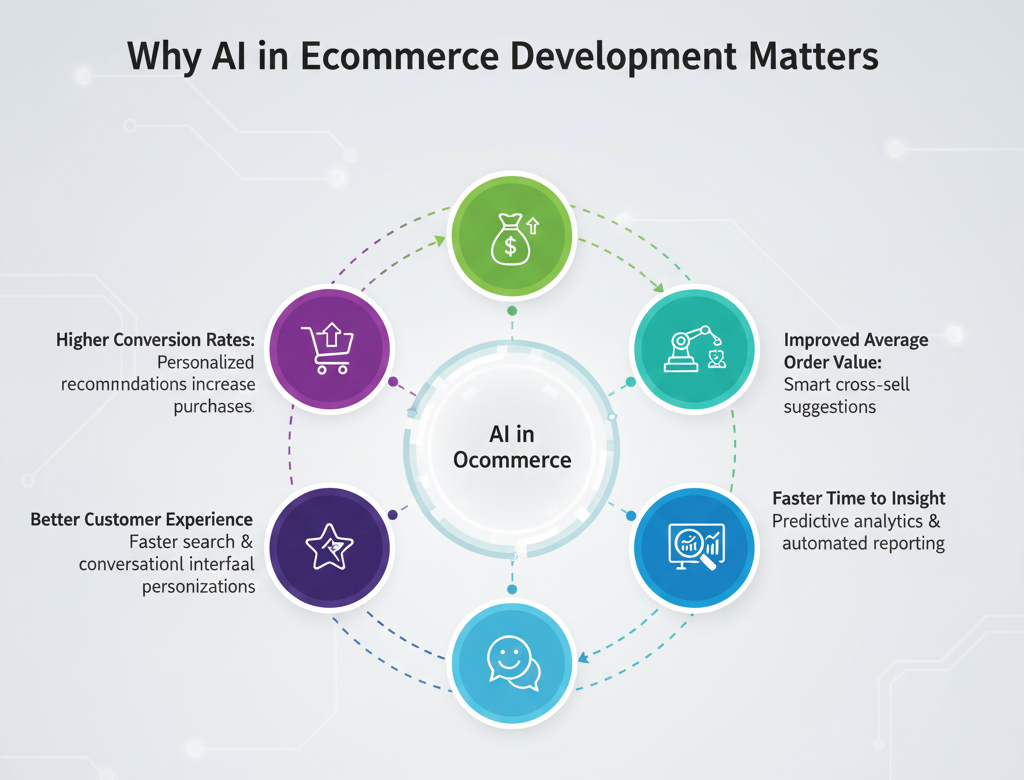
- Higher Conversion Rates: Personalized product recommendations and search improvements reduce friction and increase purchases.
- Improved Average Order Value: Smart cross-sell and upsell suggestions at the right moment raise basket size.
- Lower Operational Costs: Automation of tagging, customer support, and fraud checks reduces manual labor.
- Faster Time to Insight: Predictive analytics and automated reporting let teams act on trends sooner.
- Better Customer Experience: Faster search, relevant content, and conversational interfaces make shopping easier and more enjoyable.
- Competitive Differentiation: Advanced features like visual search or AI-powered personalization can set a brand apart in crowded markets.
These benefits compound: better personalization increases retention. This improves lifetime value and justifies further investment in AI capabilities.
Practical Use Cases and Examples
Below are concrete examples of how AI is applied in eCommerce development. Each use case includes the business problem, the AI approach, and the expected outcome.
1. Personalized Product Recommendations
- Problem: Generic product lists fail to convert repeat visitors.
- AI Approach: Use collaborative filtering and session-based recommendations to surface products based on user behavior and similar customers.
- Outcome: Higher click-through rates and increased conversion.
2. Intelligent Search and Query Understanding
- Problem: Users type vague or misspelled queries and get irrelevant results.
- AI Approach: Implement NLP-based query expansion, typo correction, and semantic search to map intent to products.
- Outcome: Reduced search abandonment and improved discovery.
3. Visual Search and Image-Based Discovery
- Problem: Customers find it hard to describe products they saw offline or on social media.
- AI Approach: Computer vision models match uploaded images to catalog items or visually similar products.
- Outcome: Faster discovery and higher engagement from mobile shoppers.
4. Dynamic Pricing and Promotions
- Problem: Static pricing misses opportunities to maximize margin or win sales during demand spikes.
- AI Approach: Reinforcement learning or rule-based optimization adjusts prices based on demand, inventory, and competitor data.
- Outcome: Improved revenue and inventory turnover.
5. Automated Product Tagging and Catalog Enrichment
- Problem: Manual tagging is slow and inconsistent for large catalogs.
- AI Approach: Use image and text classifiers to auto-generate attributes, categories, and descriptions.
- Outcome: Faster onboarding of new SKUs and better search relevance.
6. Conversational Commerce and Chatbots
- Problem: High volume of repetitive customer queries strains support teams.
- AI Approach: Deploy NLP-powered chatbots for order status, returns, and product recommendations, with escalation to humans when needed.
- Outcome: Lower support costs and faster response times.
7. Fraud Detection and Risk Scoring
- Problem: Chargebacks and fraudulent orders erode margins.
- AI Approach: Anomaly detection models flag suspicious transactions based on behavior, device, and historical patterns.
- Outcome: Reduced fraud losses and safer checkout.
8. Inventory Forecasting and Supply Chain Optimization
- Problem: Overstock and stockouts cause lost sales and wasted capital.
- AI Approach: Time-series forecasting models predict demand at the SKU and location level, enabling smarter replenishment.
- Outcome: Lower carrying costs and higher availability.
These examples show how AI in eCommerce Development touches both customer-facing features and back-office operations.
How to Start Implementing AI in eCommerce Development
A stepwise approach reduces risk and accelerates value. Here’s a practical roadmap:
- Define Clear Business Goals: Start with measurable objectives: increase conversion by X%, reduce returns by Y%, or cut support costs by Z%.
- Audit Data and Infrastructure: Assess product catalogs, user behavior logs, transaction history, and existing analytics. AI needs clean, well-structured data.
- Prioritize Use Cases: Choose high-impact, low-complexity features first (e.g., search improvements, basic recommendations).
- Build or Buy: Decide whether to use third-party AI services, open-source models, or build custom models. Many teams combine approaches.
- Prototype and Validate: Create an MVP, run A/B tests, and measure lift against control groups.
- Iterate and Scale: Improve models with more data, expand to additional features, and automate model retraining.
- Monitor and Govern: Track model performance, bias, and drift. Implement logging, explainability, and rollback mechanisms.
- Invest in Talent and Partnerships: Hire or partner with data scientists, ML engineers, and experienced eCommerce developers.
This pragmatic path keeps projects focused on business outcomes rather than chasing technology for its own sake.
AI for eCommerce Platforms and Tools
Many eCommerce platforms and tools now offer AI capabilities out of the box or via integrations. Understanding these options helps teams choose the right stack.
- Platform-Level AI: Major platforms provide built-in AI features. For example, merchants using hosted platforms can enable recommendation widgets, search enhancements, and automated merchandising.
- Third-Party AI Services: Specialized vendors offer plug-and-play solutions for visual search, personalization, fraud detection, and more. These services reduce time to value.
- Custom AI Models: For unique product assortments or proprietary data advantages, building custom models can yield superior results but requires more investment.
- Headless and API-First Architectures: A headless approach decouples front-end experiences from back-end commerce engines, making it easier to inject AI-driven components into any touchpoint.
When evaluating options, consider integration complexity, data ownership, latency, and cost.
Shopify AI and Platform-Specific Considerations
Shopify and similar platforms have introduced AI features that make it easier for merchants to adopt intelligent capabilities. Shopify AI tools include automated product descriptions, image generation, and merchandising suggestions that integrate directly into the merchant admin.
- Shopify AI Benefits: Quick setup, low technical overhead, and immediate improvements in content and merchandising.
- When to Use Platform AI: Ideal for small to mid-size merchants who want fast wins without building custom infrastructure.
- When to Build Custom: Larger merchants or those with unique catalogs may need bespoke models for recommendations, visual search, or dynamic pricing.
If you’re using Shopify, consider how Shopify website development and custom apps can extend built-in AI features with proprietary data and workflows.
Measuring Success and Key Metrics
To justify AI investments, track metrics that tie directly to business goals:
- Conversion Rate: Measure before and after AI features like recommendations or search improvements.
- Average Order Value: Track the impact of cross-sell and upsell algorithms.
- Customer Lifetime Value
Evaluate retention improvements from personalization. - Search Success Rate: Percentage of searches that lead to clicks or purchases.
- Cart Abandonment Rate: Monitor changes after checkout optimizations or fraud reduction.
- Support Ticket Volume and Resolution Time: Assess chatbot effectiveness and automation impact.
- Inventory Turnover and Stockouts: Measure improvements from forecasting models.
Use A/B testing and holdout groups to isolate the causal impact of AI features.
Common Implementation Patterns
Teams often follow one of several patterns when integrating AI into eCommerce development:
- Widget-Based Integration: Add recommendation or search widgets to existing pages with minimal engineering.
- API-Driven Microservices: Deploy AI as separate services that the front end calls for personalization, search, or fraud checks.
- Edge and Client-Side Models: Run lightweight models in the browser or mobile app for low-latency personalization.
- Server-Side Batch Processing: Precompute recommendations and forecasts during off-peak hours and serve cached results.
- Hybrid Approaches: Combine server-side heavy lifting with client-side personalization for the best balance of performance and freshness.
Choose the pattern that fits your latency, scale, and engineering constraints.
Challenges and How to Mitigate Them
AI projects in eCommerce face several recurring challenges. Here’s how to address them:
Data Quality and Availability
- Challenge: Incomplete or inconsistent product and behavioral data undermines model accuracy.
- Mitigation: Invest in data pipelines, catalog normalization, and event tracking.
Cold Start Problems
- Challenge: New users or products lack historical data.
- Mitigation: Use content-based recommendations, popularity signals, and contextual cues.
Model Drift and Maintenance
- Challenge: Models degrade as user behavior changes.
- Mitigation: Implement automated retraining, monitoring, and alerting.
Privacy and Compliance
- Challenge: Regulations and customer expectations limit data usage.
- Mitigation: Use privacy-preserving techniques, anonymization, and clear consent flows.
Integration Complexity
- Challenge: Legacy systems and monolithic platforms make integration hard.
- Mitigation: Adopt APIs, middleware, and a headless architecture where possible.
Cost and ROI Uncertainty
- Challenge: High upfront costs with unclear payback.
- Mitigation: Start with MVPs, measure lift, and scale only proven features.
Addressing these challenges early prevents wasted effort and improves the chance of success.
AI in eCommerce Development for Small and Medium Businesses
Small and medium businesses (SMBs) can benefit from AI without large budgets:
- Use Managed Services: Leverage third-party AI providers for search, recommendations, and chat.
- Adopt Platform Features: Enable built-in AI features on platforms like Shopify to get immediate value.
- Focus on High-Impact Areas: Prioritize search relevance and product recommendations before tackling complex forecasting.
- Measure and Iterate: Small experiments with clear metrics can justify incremental investment.
For SMBs, the right mix of off-the-shelf tools and selective custom work delivers the best ROI.
The Role of AI in e-Commerce Strategy
Understanding the role of AI in e-commerce helps align technical work with business strategy. AI should be viewed as:
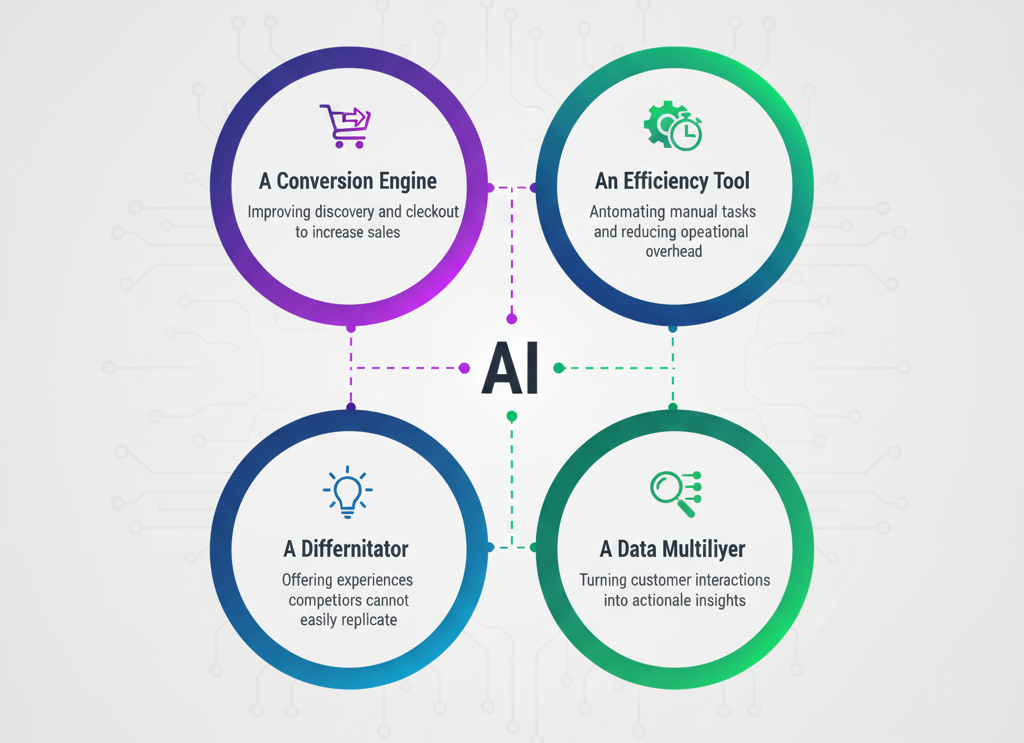
- A Conversion Engine: Improving discovery and checkout to increase sales.
- An Efficiency Tool: Automating manual tasks and reducing operational overhead.
- A Differentiator: Offering experiences competitors cannot easily replicate.
- A Data Multiplier: Turning customer interactions into actionable insights that inform product, marketing, and supply chain decisions.
When AI is embedded into the product roadmap rather than treated as a separate project, it becomes a strategic asset.
Building an AI-Ready eCommerce Architecture
A robust architecture supports AI features at scale:
- Event-Driven Data Layer: Capture user events, catalog changes, and transactions in real time.
- Feature Store: Centralize computed features for reuse across models and services.
- Model Serving Infrastructure: Low-latency APIs for real-time personalization and scoring.
- Experimentation Platform: A/B testing and holdout management to validate model changes.
- Monitoring and Observability: Track model performance, latency, and business KPIs.
- Data Governance: Policies for data access, retention, and privacy compliance.
Investing in these components reduces technical debt and accelerates future AI initiatives.
Choosing the Right Partners and Tools
Most teams combine internal development with external partners. Consider these factors when selecting vendors or tools:
- Domain Experience: Look for partners with eCommerce-specific AI experience.
- Integration Capabilities: Ensure the solution works with your platform, whether it’s a hosted store or a headless stack.
- Data Ownership and Portability: Prefer vendors that allow you to export data and models.
- Latency and Scalability: Verify performance under peak traffic.
- Cost Model: Understand pricing for API calls, model training, and storage.
- Support and SLAs: Production AI needs reliable support and clear escalation paths.
For many merchants, a hybrid approach—using managed services for common features and building custom models for unique advantages—works best.
Future Trends in AI for eCommerce Development
AI continues to evolve rapidly. Key trends to watch include:
- Multimodal Models: Unified models that understand text, images, and audio will power richer search and discovery.
- Generative AI for Content: Automated product descriptions, creative assets, and personalized marketing copy.
- Federated and Privacy-Preserving Learning: Models trained across devices without centralizing raw data.
- Real-Time Personalization at Scale: Low-latency systems that adapt experiences within a single session.
- AI-Driven Merchandising and Creative Optimization: Automated testing of layouts, creatives, and promotions.
- Voice and Conversational Commerce: Natural voice interactions for discovery and checkout.
Staying informed about these trends helps teams plan long-term roadmaps and avoid short-lived fads.
Practical Checklist for Teams Starting with AI in eCommerce Development
- Define one or two measurable goals.
- Audit your data and fix tracking gaps.
- Choose a high-impact MVP (search, recommendations, or chat).
- Decide build vs buy based on time to value and data advantage.
- Instrument experiments and measure lift with holdouts.
- Plan for model maintenance and monitoring.
- Ensure privacy and compliance are baked into design.
- Document APIs and data contracts for future integrations.
This checklist keeps projects focused and accountable.
Conclusion
AI in eCommerce Development is a practical, measurable way to improve customer experience, increase revenue, and reduce operational costs. From smarter search and personalized recommendations to fraud detection and inventory forecasting, AI touches every part of the commerce stack. Start with clear business goals, prioritize high-impact use cases, and choose the right mix of platform features, third-party services, and custom models.
For merchants using platforms like Shopify, Shopify AI features, and Shopify website development extensions provide fast paths to value. For businesses that need deeper differentiation, custom AI models and headless architectures deliver unique advantages. Whether you are a small merchant or an enterprise, the right approach balances speed, cost, and long-term data strategy.
If you are looking for local expertise to implement these ideas. Consider partnering with an ecommerce development company in Chandigarh to build, integrate, and scale AI-driven commerce solutions tailored to your market.